

What actually motivates you to do your work and show up every day? Is it the paycheck? Accolades? Something else?
If you asked managers, the most common answers tend to be recognition, pay, or pressure. But what really keeps us going when we sit down at the studio or the keyboard? What if management and leadership have it wrong on what motivates their employees?
According to a landmark study, the answer was none of these and surprisingly simple:
“Of all the positive events that influence inner work life, the single most powerful is progress in meaningful work.” (p. 72)
Published in 2011, The Progress Principle by Amabile and Kramer is one of my favorite and most recommended books. Whether you are a worker, manager, or leader, the book argues that our productive and creative lives should be built on the progress principle (making progress on meaningful work), and that we should prioritize removing the obstacles that cause the opposite of progress: setbacks at work.
There is a strong overlap between this lived experience of making progress and a wide range of my own work on self-tracking, quantified self experiments, and productivity practices. I’ve been quietly managing my goals, projects, and tasks based on this finding for more than a decade. Reading this book finally gave me the vocabulary to put it into words.
Here are the book’s key ideas that resonated most with me as well as my book notes and a few takeaways.
My Quick Take Book Review
- ⭐⭐⭐⭐⭐ I rated this book a 5 out of 5 on Goodreads.
- Would I recommend it? Definitely. This is one of my most recommended books for anyone pursuing peak performance on their own or for their teams.
- Would I read it again? Yes, this is a book I plan to pick up again, though I’d love to see a companion book looking at making progress in a wider range of scenarios like art or startups.
- What was missing? The book is manager-centric and misses out on the more universal application (like flow) that is applicable to solo creators too.
What I Got Out of This Book
When I read this book in 2021, I was in the midst of several ongoing work and creative projects at the time, sadly most of which would fail. Emotionally, it can be hard to not see what you are pursuing in terms of a binary outcome: success or failure.
I had spent several months writing a book tentatively titled The Science of Goals, focusing on the operational side of goal pursuit. Rather than relegating goals to setting and final outcomes, I was arguing that it was essential to set mid-term goals, track your progress using self-tracking technology, and do regular reviews and reflection on your pursuit, progress, and setbacks. My argument was that by instrumenting and quantifying your goals and visualizing the data through dashboards, you could better sustain your effort, choose your next move, and eventually reach your goals.
As the first draft manuscript deadline loomed, Amabile’s book stuck particularly hard, because it gave an emotional and lived experience to back up the operational and practice-heavy approach I was advocating for. While I eventually got caught up with other projects and didn’t finish or publish the book (writing a book is hard!), a strong throughline remained with me in the years ahead. While we should construct our in-the-moment work lives on flow, we should also capture our progress and make it tangible in ways that remind us of the progress we are making, because it’s the lived experience of daily progress on meaningful work that motivates us.
Background: Teresa Amabile, the Diary Study and Our Inner Work Life
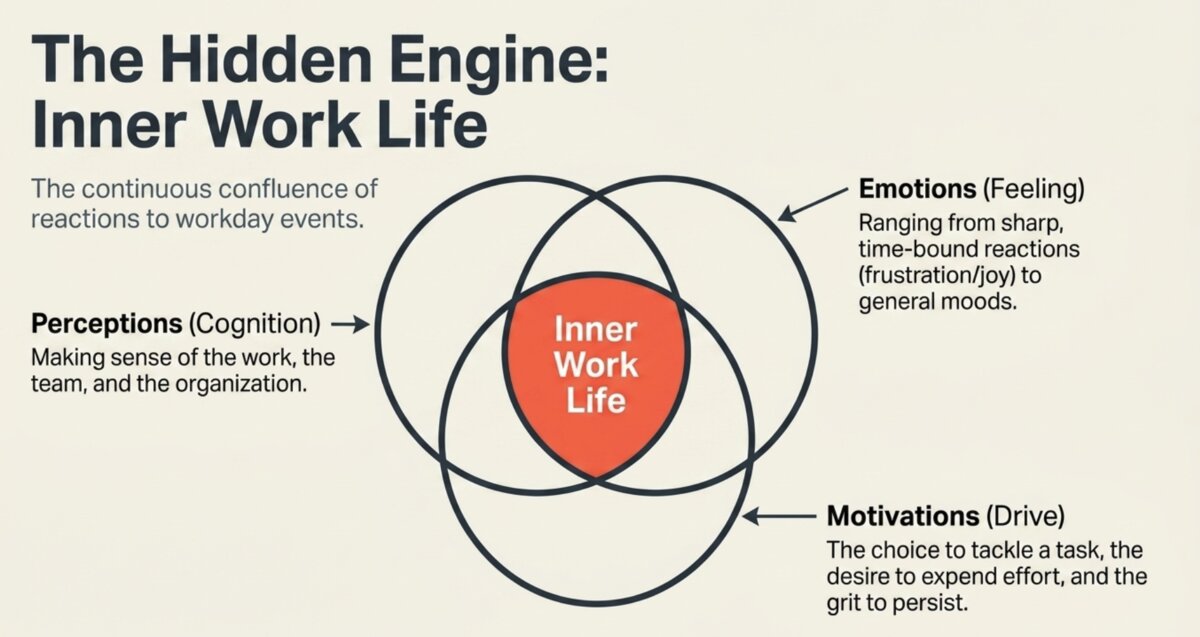
Teresa Amabile is an American academic at Harvard Business School. She is known for her research on creativity and motivation in organizations. With her co-author Steven Kramer, they collected, over several years, what would become one of the largest datasets of its kind on the lived, in-the-moment experience of workers: roughly 12,000 daily diary entries from 26 project teams. Unlike surveys or interviews, the diary method captures data on emotions, perceptions, and motivations as they happened, rather than self-reported memories or interpretations.
From this data, they discovered that our work and creative experience is not a static state but a dynamic system that shapes our performance. They call this our “inner work life” and define it as the confluence of perceptions, emotions, and motivations that we experience as we react to and make sense of the events of our workday.
Our Best Work Days Happen When We Make Progress
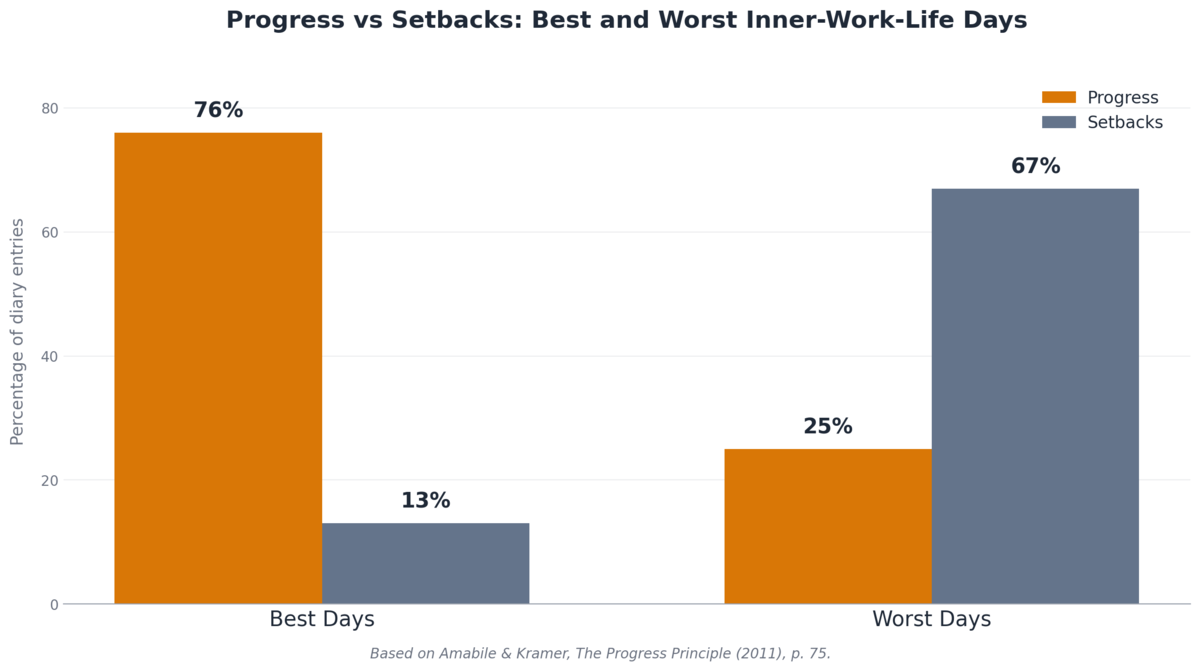
The most striking finding from the diary study was that workers’ best days had the most reported events where they were making progress. By contrast, their worst days were the reverse and more associated with setbacks at work.
The numbers showed an almost mirror-image pattern:
- On best days, 76% of diary entries reported progress; only 13% reported setbacks
- On worst days, only 25% reported progress; 67% reported setbacks
- 28% of small events triggered big emotional reactions, far more than participants expected
Creativity was also better. Workers in positive moods were 50% more likely to have a creative idea on those days.
While the data showed progress as the dominant factor on best vs worst days for employees, managers who were surveyed on what they thought motivated their employees picked recognition as the most important factor and ranked “supporting progress” as dead last among five candidate factors.
Progress in Meaningful Work as THE Daily Motivator
“Most people have strong intrinsic motivation to do their work, at least early in their careers. That motivation exists, and continues, until something gets in the way.” (Amabile & Kramer, p. 34)
Most workers are intrinsically motivated to work and naturally want to do good work. They don’t need external motivation or micromanagement. They need obstacles and blockers removed, because while setbacks tend to result in bad work days, it’s daily progress on work that matters to them that tends to result in their best work days, creativity, and peak performance.
Importantly, the bar for “meaningful work” is lower than most readers might assume:
“To be meaningful, your work doesn’t have to have profound importance to society… What matters is whether you perceive your work as contributing value to something or someone who matters (even your team, yourself, or your family).” (p. 88)
In our careers and work lives, we often emphasize the importance of finding purpose and deeper meaning. In our goals, we focus on achievements and the final outcome. But we can miss the journey itself, getting depressed by setbacks and the long middle along the way.
As I work on my startup app or finish my next album, I have to remind myself regularly about the progress I’m making, despite how much work is still ahead. The lived experience of making progress on meaningful work might be a healthier, more sustainable way to live as we work toward those goals. Each step matters and can ultimately help you get there in your own time and in your own way.
Self-Aware Progress Tracking Practice: My Lived Application of the Progress Principle
As someone who obsessed and wrote extensively about quantified self and self-tracking for many years, it’s remarkable to me to see how my tracking practices evolved over time in a way that aligns with the progress principle. This book gave me the vocabulary even though my practice came before. Re-reading this book and writing this review has sharpened how I see my own self-aware goal pursuit practices.
Interestingly, individual health and productivity experiments (like tracking my mood or poop) were one-offs because they didn’t empower me in my daily progress practices. By contrast, several areas have evolved in ways that are central to my own internal operating system.
Here are a few:
- Morning Pages as Personal Diary Study: I journal at least 2-3 times per week. Besides being a brain dump for writing, it helps me record my inner work life events with clients and as a solo-creator. Reading them and orienting my day based on them helps me see invisible patterns, remove blockers, and navigate sense-making in the moment.
- Weekly Reviews: Reviewing and Tracking Progress: David Allen’s Getting Things Done taught me a few simple organizational practices that I have applied in my life and that continue to fuel my approach to productivity, task tracking, and weekly reviews. My data-driven weekly review remains a cornerstone habit because of its usefulness and meaningfulness as an operating system. By tracking and pulling my most impactful data, I can look back on my week to see the progress I made, where I got stuck, and how to iterate and plan ahead.
- Writing Sprint Campaigns and Session Tracker: Maintaining a writing habit is hard, especially since research-backed essays take a lot of time and often multiple sessions. So, as I described in a recent post, I started to carve out time in my calendar and record the small wins from each session. The end result is sustained progress and built-up momentum resulting in more published blog posts.
- Producer Pipelines: Small Regular Moves That Move the Work Forward: As a music producer working on my next album, the principle shows up often. My recent Producer Pipelines post named what working producers do without realizing it: design their own systems for advancing tracks one decision at a time. At Playback Pilot, one of the product’s internal north star metrics is “making moves,” which is Karl Weick’s small wins applied to music. Having a track in a pipeline means that the move you make today gets you closer to a finished song.
This idea pairs naturally with flow, which I’ve written about. Flow happens IN the work while the Progress Principle lives BETWEEN our moments of work. Both make you feel good and are intrinsic motivators that emerge from doing meaningful work, not from external rewards or recognition.
Concluding Thought: How to Live the Progress Principle
“People are more creative when they are driven primarily by intrinsic motivators: the interest, enjoyment, satisfaction, and challenge of the work itself.” (p. 52)
While the book itself tends to feel manager-centric, the core takeaways are universally applicable and can be integrated and lived by each of us every day.
- Notice your daily progress, and write it down somewhere. We tend to forget what we did and remember what we didn’t. We overweigh setbacks and underweigh the wins. By tracking and writing something down, you make your progress visible and tangible.
- Lower the bar on “meaningful.” The progress you make day to day doesn’t have to change the world. It just has to be meaningful to you. If you are making moves that get you closer to your album, your blog post, your side project, your whatever, that’s all that matters.
- Engineer small wins into your day. Feeling stuck or having a bad day? Seek out a small opportunity that delivers a small win. It could be one sentence written, one drop in the bucket, one session logged. Just do it and call it a progress win.
At the end of the day, living a life centered on progress is about recognition of the meaningful steps rather than measurement of the whole. Frequency of showing up beats magnitude of impact.
As Amabile and Kramer put it:
“Progress lives in the everyday, not just in quarterly reports or milestone checkpoints.” (p. 184)
[Bonus] The Reflection Journey Template I Built From This Book
Check out the Reflection Journey I created based on this book.
Inspired by Teresa Amabile, the essence of the “Progress Principle” is finding joy and motivation in our daily achievements, no matter how small. Celebrating these moments and wins can dramatically improve your workday, motivation, and overall happiness. Small wins can lead us to big dreams. Let’s harness the power of progress by reflecting on our daily achievements and the steps we take towards our larger goals.
- What progress did you make today or recently towards a goal or task that felt meaningful?
- How did or does your progress make you feel?
- What is one or two small yet achievable steps you can take next to continue this progress?
➡ Try it at StayReflective.com
Related Reading
More from me on goals, progress, and flow:
- The Ostrich Problem: Why do we avoid checking our goal progress? — The flip side of the progress principle: if felt progress is the #1 motivator, then avoiding progress information is how we quietly starve our own inner work life.
- Stuck in the Middle: Why Motivation Collapses Halfway to Your Goal — The midpoint slump as a failure of felt progress, and design moves to restore small wins.
- Is This the Long Middle or the Desperate End? — Reading where you are in a long-arc pursuit when progress is ambiguous; no-regret moves as partial-credit progress. The daily-scale fuel here meets multi-year-scale uncertainty.
- 80 Hours, 9 Posts: What a 7-Week Writing Sprint Taught Me — Live evidence of small daily wins compounding into shipped work.
- Tracking Flow — The sibling intrinsic motivator that operates IN the work, where the Progress Principle lives BETWEEN work moments.
Companion book reviews:
- Slow Productivity by Cal Newport — Natural pace and McPhee’s “drop in the bucket” as the Progress Principle in practice.
- Finish by Jon Acuff — Perfectionism as the enemy of finishing; cutting the goal in half to restore momentum.
- Feel-Good Productivity by Ali Abdaal — Feeling good as the fuel for productive work, not the reward; the emotional sibling to the Progress Principle.
- The Courage to Be Disliked by Kishimi & Koga — Meaning through contribution to others; a sibling to “meaningful work” as motivator.
The original idea:
- Karl Weick, “Small Wins: Redefining the Scale of Social Problems” (1984) — The conceptual ancestor of the progress principle.
References
Amabile, T., & Kramer, S. (2011). The Progress Principle: Using Small Wins to Ignite Joy, Engagement, and Creativity at Work. Harvard Business Press.
AIDA (AI Disclosure Acknowledgement): This blog post was researched and written by the author. AI tools (Claude Code) were used to assist with quote organization, smart note extraction, and structural editing. Images were generated by Google’s NotebookLM.