
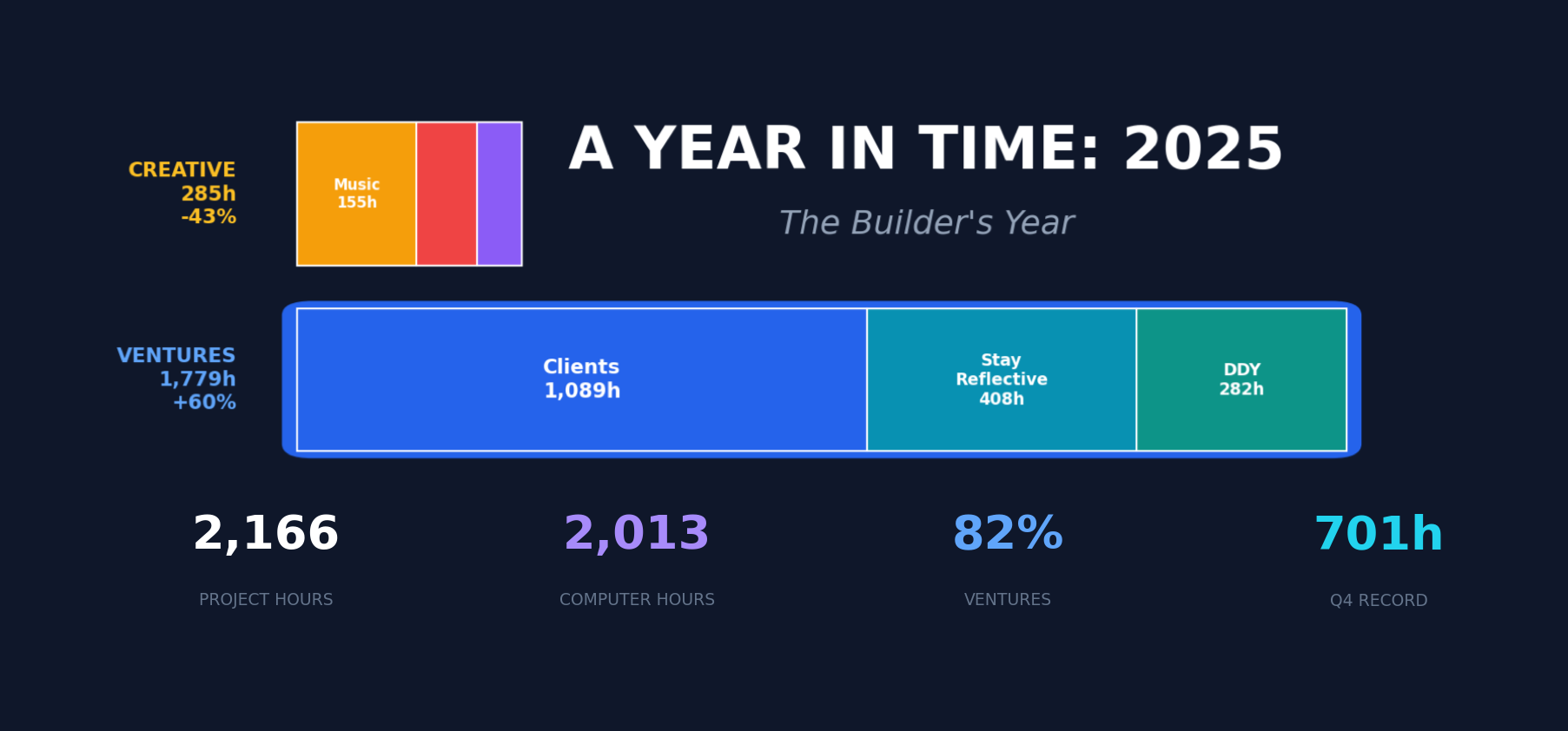
Time management is a zero-sum game. Every hour invested in one area is an hour divested from something else.
In 2025, I tracked 2,166 hours of my work and personal projects. This is 311 more hours than last year, which was a dramatic increase compared to previous years. I had to make trade-offs, sometimes intentionally though often as a byproduct of time pulled into one area over another.
My 2025 time tracking data tells a story of those tradeoffs, shifts, trends and patterns. My last year saw a surge in building software products and scaling technical development. But even with my overall project and computer time increases, this shift into a “builder mode” resulted in time subtracted from exploration, marketing, creative experimentation and some personal hobbies. You can’t do it all. There are only 24 hours in a day.
Here is a visualization that best summarizes my year in time:
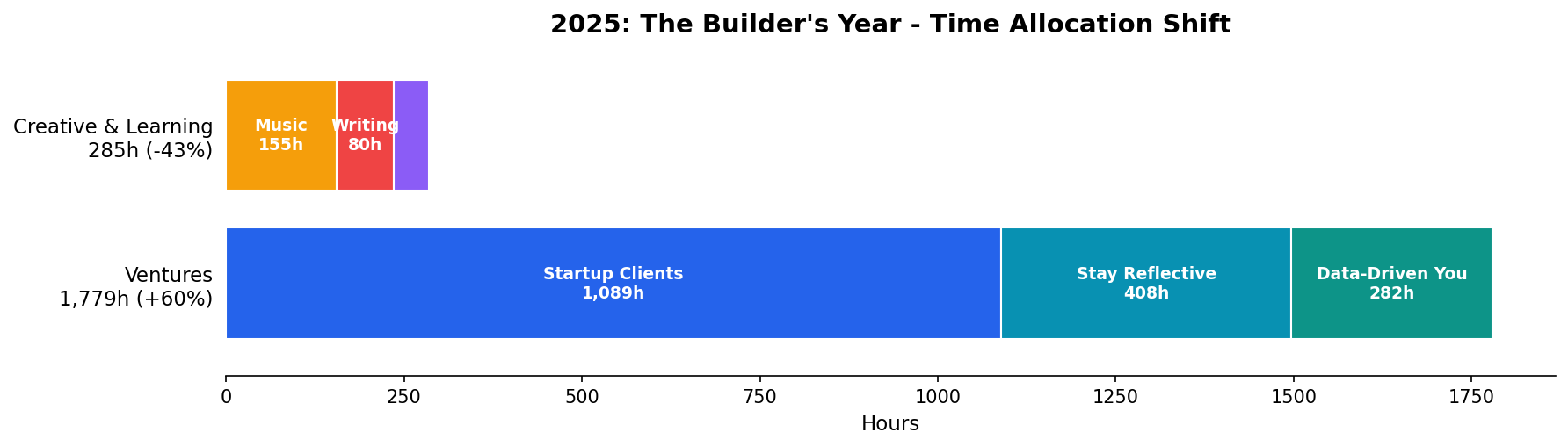
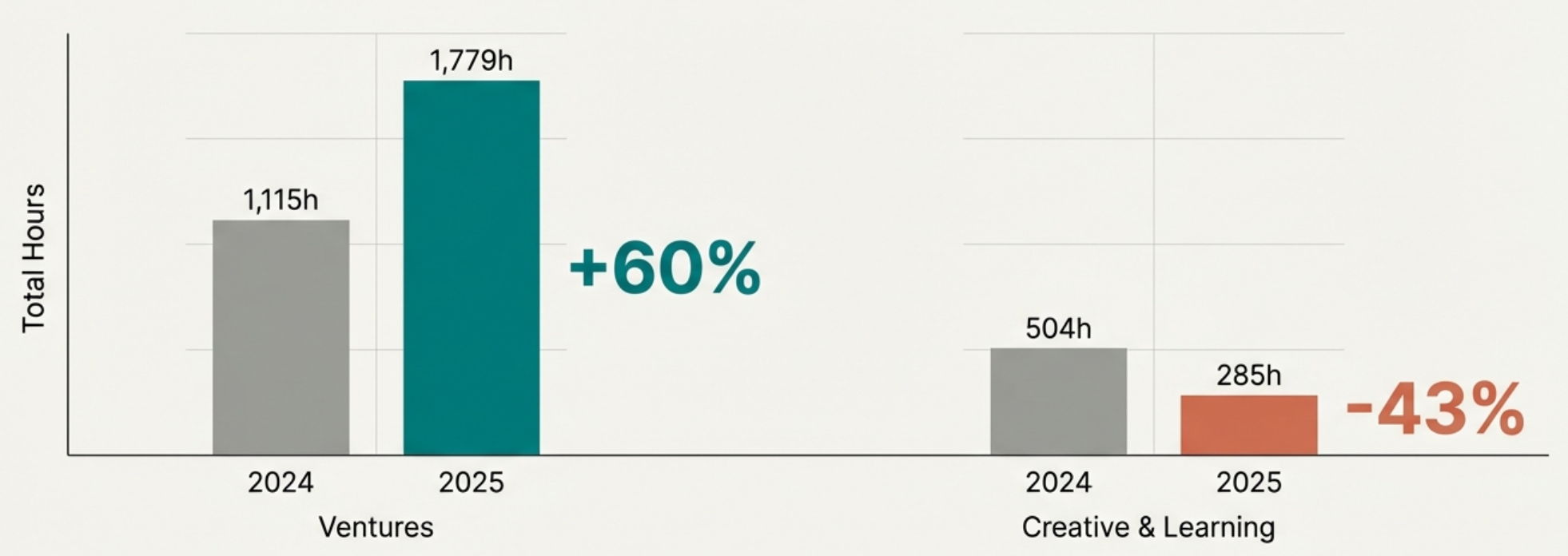
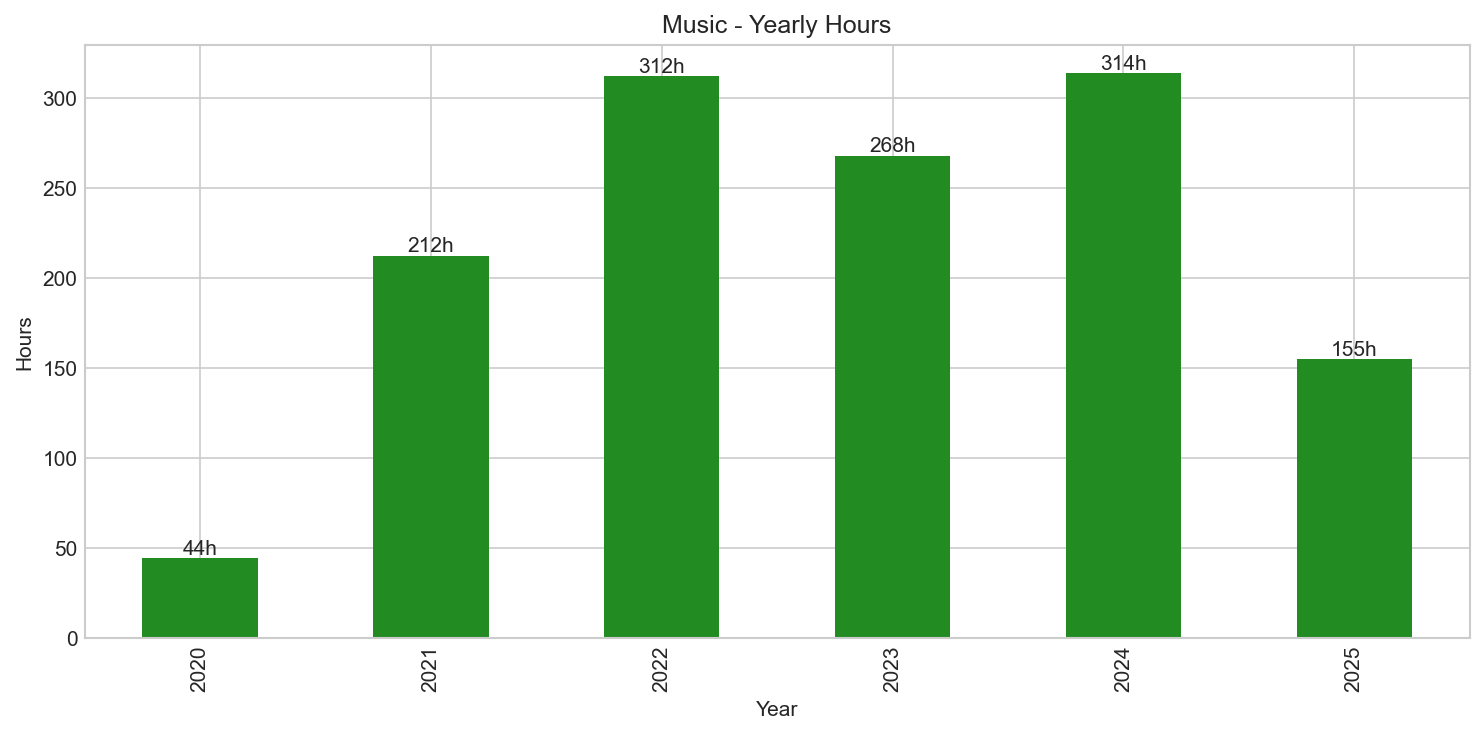
Between 2024 and 2025, ventures surged +60% (1,115h → 1,779h) while Creative & Learning contracted -43% (504h → 285h). The ratio flipped from roughly 70/30 to 82/18. The result: a surge in building, a retreat from creating.
For example, I wrote and published few articles. My music time was cut nearly in half, I worked with fewer music collaborators, and I completed just one album last year, compared to two the previous year. I traveled 50% of the year, which was a significant increase and, even when working remotely, still came at certain costs. For example, my running distance dropped over 50%, though it was replaced by more time outdoors camping and hiking. I maintained my pickleball routine. So overall my exercise was largely stable year-on-year. My sleep varied dramatically throughout the year.
I’ve been more or less continuously tracking my time since 2013. My time logs, along with data I collect on my health, exercise, sleep, screentime and a few other areas, give me an incredible dataset to explore and examine patterns and trends in my focus and attention over the years. While my yearly data reviews are the public manifestation of this reflective practice, the main act comes in the form of my data-driven weekly reviews whose chief benefit is clarity, clarity about what I care about, where my time has gone and where I hope to put my efforts in the days and weeks ahead.
In this post, I want to dive into my year in data from a few different angles. First, I’ll look at the 2025’s biggest pattern and shift, namely towards more hands-on technical software development. Next, I’ll go through my key time indicators from computer usage and screentime as well as a breakdown of key areas, projects and creativity.
The Great Shift: My Builder’s Year
What happens when client work and your own startup are both demanding more? You work more—but something eventually has to give.
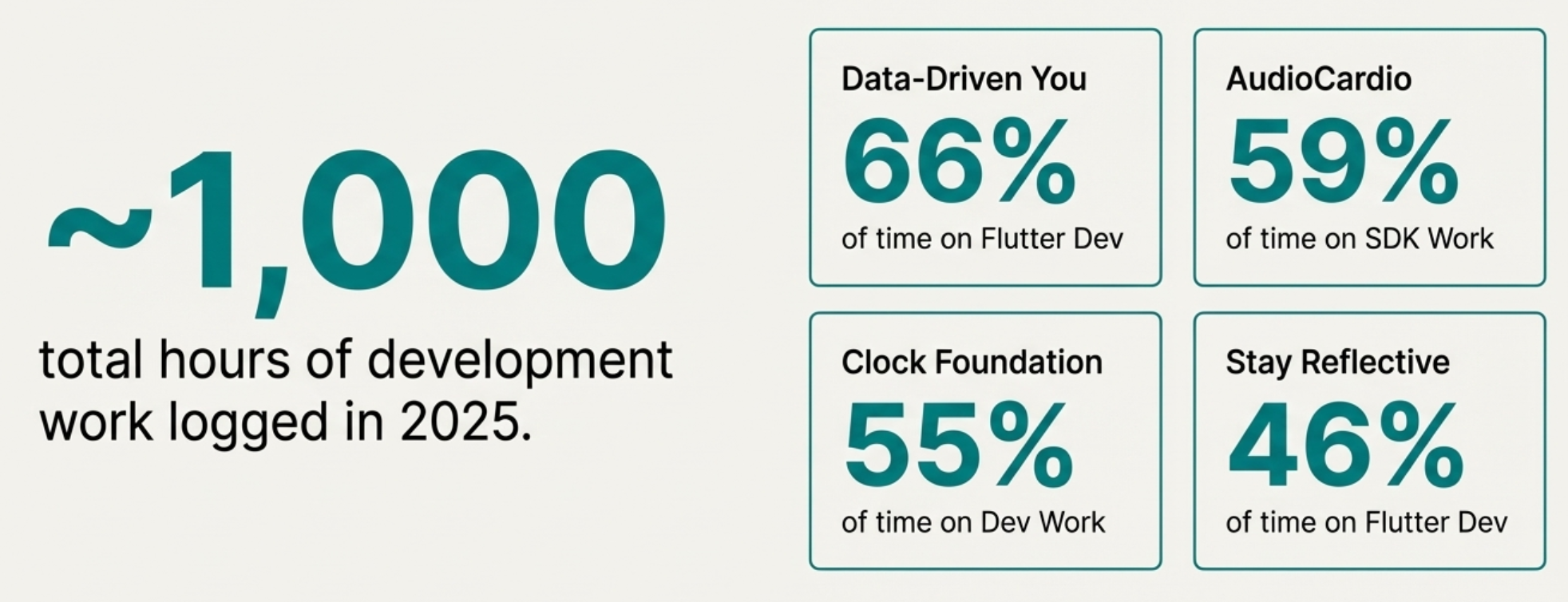
Software Development Work: ~1000 hours
Venture Building: Increased by 60% in 2025
I have worked as a technical product manager and data-driven growth marketer at early-stage healthtech and biotech for the last several years, and I continue to lead, design, code, launch and scale product-led organizations. I continue to build and launch my own products too, and I often share open source code. In recent years and on projects, my time tended to get spread across a range of responsibilities spanning strategy, tech, and growth/marketing. This changed in 2025, aka The Builder’s Year.
In 2025, development effort and intensity surged across all ventures, totaling nearly 1,000 hours of coding and software development. Intriguingly, while we often think about AI coding agents as replacing software developers, in my case the rise of these tools and technologies fueled more hands-on development and product building. In fact, in 2025, over half the time in three of my four active ventures was dedicated exclusively to development, signaling a portfolio-wide shift from planning and cross-functional needs to execution.
Here are the numbers:
| Area / Category | 2024 | 2025 | Change |
|---|---|---|---|
| Ventures (Clock Foundation, AudioCardio, Stay Reflective, Data-Driven You) | 1,115 hrs | 1,779 hrs | +60% |
| Creative & Learning (Music, Writing, Studies) | 504 hrs | 285 hrs | -43% |
This software and product development-first shift shows up in every venture:
- Data-Driven You: 66% Flutter Dev
- AudioCardio: 59% SDK Work
- Clock Foundation: 55% Dev Work
- Stay Reflective: 46% Flutter Dev
In summary, creative projects (Music, Writing) and formal learning (Studies) declined while technical ventures scaled dramatically. The composition changed: more dev work, less marketing; more finishing, less experimentation.
Resurgence of Personal App Building
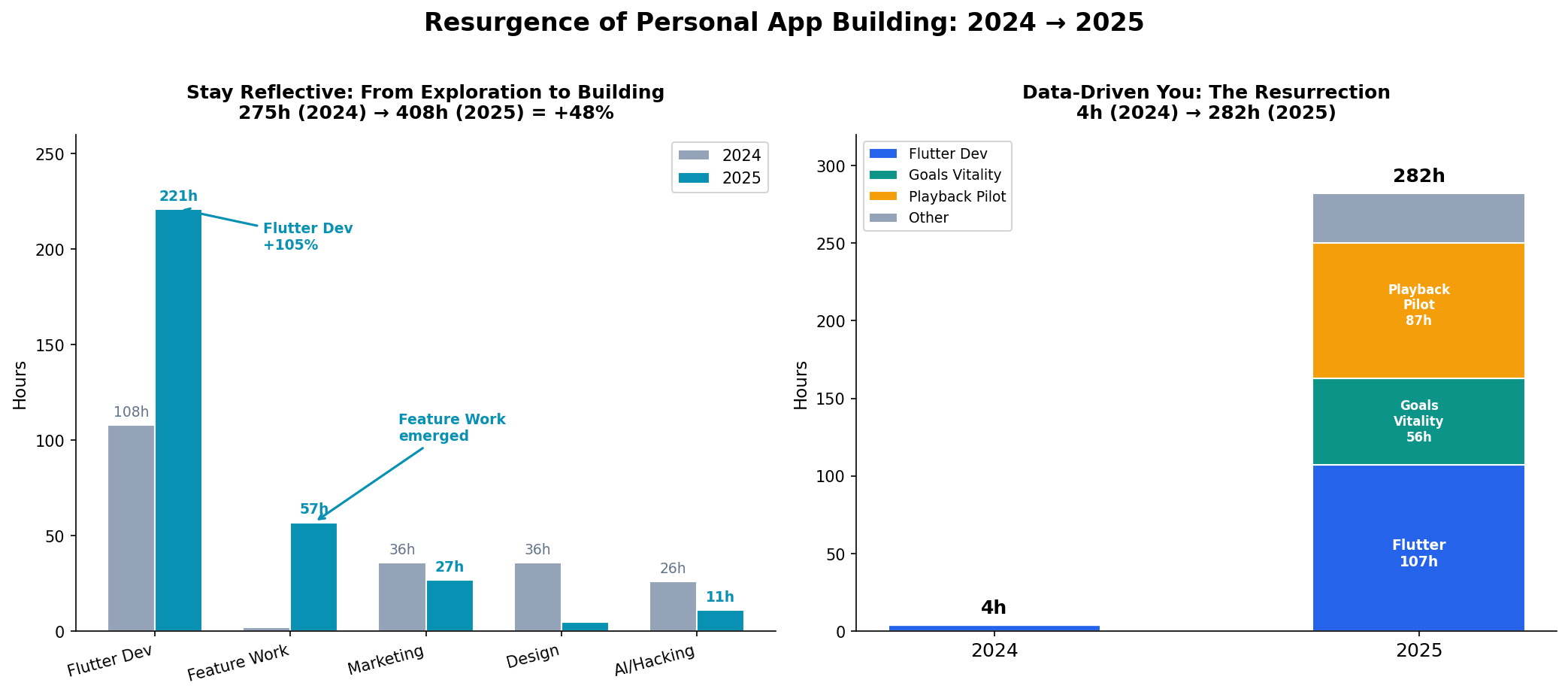 Stay Reflective shifted from exploration to execution (+48%), with Flutter dev doubling. Data-Driven You went from dormant (4h) to active development (282h), spawning Goals Vitality and Playback Pilot.
I’ve long been fascinated by the intersection and melding of personal data and self-awareness/self-improvement through technology and apps.
In 2025, I leaned more and more into Flutter development through my client and personal app development work. With the help of Claude Code, in particular, I’ve made a lot of progress on my own apps.
Stay Reflective: From Exploration to Building
About two years ago I launched my first pilot helping people reflect using AI follow-up questions, and since then, this idea has emerged as StayReflective.com, a mobile app and website that has helped thousands of people reflect and navigate life and decisions using a Socratic form of AI.
For Stay Reflective, I’ve integrated and added reflection facilitator tools allowing teachers, coaches and thought leaders to create and scale interactive reflection journeys themselves. I’ve added new and improved design, reduced technical debt and continue to explore how we can use AI to augment our humanness through self-awareness and thoughtful reframing and check-ins.
“Data-Driven You”: The Resurgence of Data-Driven Productivity Apps
“Data-Driven You” is a term I came up with many years ago which I define as leveraging data and AI to empower human growth, change and awareness. I’ve written, blogged and built several experimental projects in this space, including Quantified Self (QS) Ledger, my top open source project—a free tool for data collection and personal data analysis. It’s easier than ever to track aspects of our lives and use that tracking data and our usage of certain tools to create transformative product experiences.
While we often frame AI and technology in general as a form of automation in which human work gets replaced by machines, I believe there is still a lot we can do and create by using technology to empower humans.
How might AI tools enable us to be better and different humans (including such higher cognitive functions like decision-making, self-reflection and even creativity)?
I’m currently building a couple of data-driven “productivity” and reflection-centered apps and products, geared towards working professionals and creatives. Creative work and goals are really hard to start, continue and finish. By nudging and inviting humans to check-in, monitor progress and identify meaningful next actions, I hope to make the pursuit of goals easier, better and more fulfilling.
One example is PlaybackPilot.com, an app I’m building to help music makers finish more music, faster.
Key Time Indicators (KTIs)
Where did my days and time go in 2025?
The short answer: building. I spent 2,013 hours on my computer and logged 2,166 project hours (+17% from 2024 and my highest tracked year ever!).
📊 Total Screen Time: 2517 hrs
| Metric | 2025 | 2024 | Change |
|---|---|---|---|
| Project Hours (Toggl) | 2,166 hrs | 1,855 hrs | +17% |
| Computer Hours (RescueTime) | 2,013 hrs | 1,756 hrs | +15% |
| Productivity Ratio | 86% | 87% | -1% |
| Phone Time (iPhone) | 451 hrs | 518 hrs | -13% |
| Tablet Time (iPad) | 53 hrs | 271.5 hrs | -80% |
| Total Screen Time | 2,517 hrs | 2,546 hrs | -1% |
| 📺 YouTube | 136 hrs | 242 hrs | -44% |
- Along with 2000+ hours on my computer, I also spent about 451h on my phone and 53 hours on my iPad (broken part of the year). This translates to 2,517 hours of device screentime or 6 hours and 53 minutes per day.
- Despite a +15% increase in computer time, total screen time stayed essentially the same because phone (-13%) and iPad (-80%) dropped significantly.
- YouTube dropped 44%—an intentional goal from 2024, finally delivered. That’s 106 fewer hours of passive consumption.
💻 Computer Time: 2,013 hours
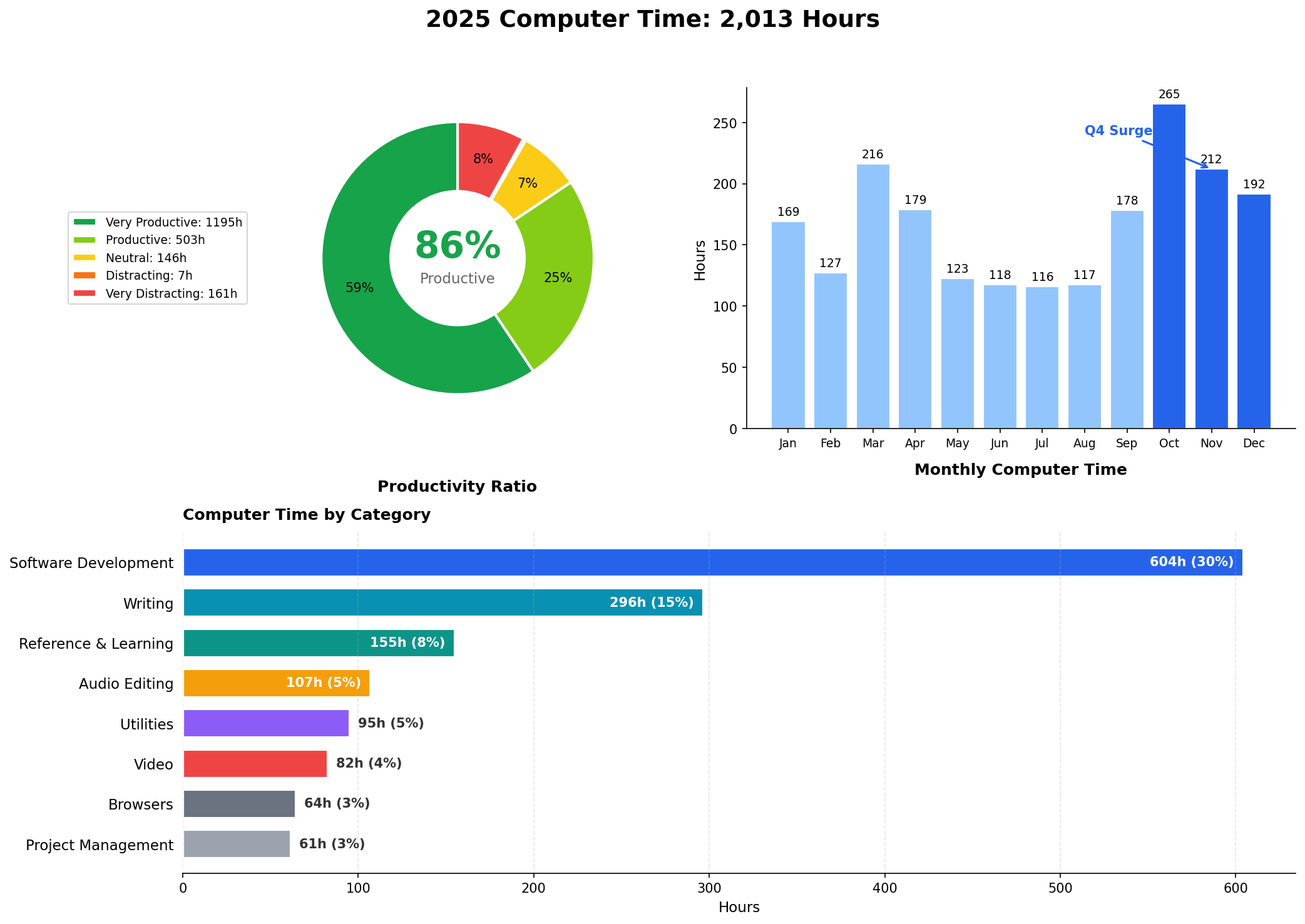
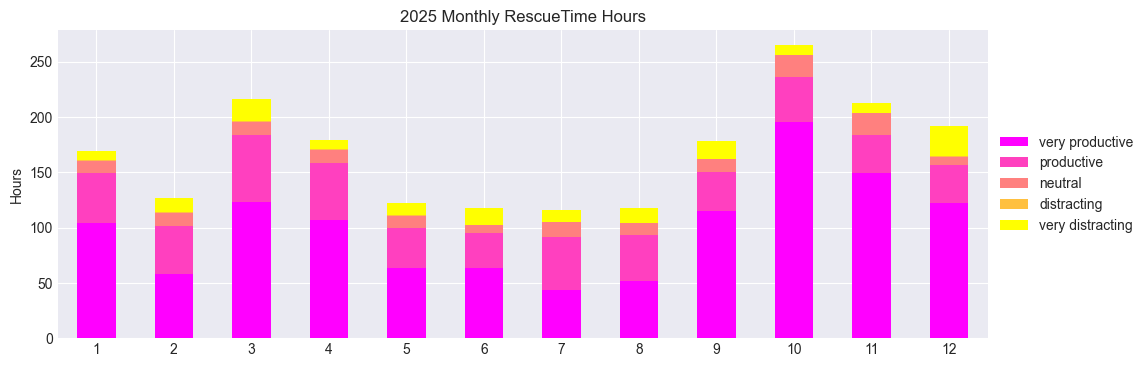
 RescueTime tracked 2,013 hours across 325 days. Software Development dominated at 30%, with 86% of time rated productive. Note the Q4 surge: Oct-Dec averaged 223h/month vs 138h/month earlier in the year.
- 325 days tracked (-10 days)
- 40 computer free days
- 6.2 hrs/day average (+15% from 5.4 hrs)
Top Computer Usage Categories:
| Category | 2025 | 2024 | Change |
|---|---|---|---|
| Software Development | 604 hrs | 244 hrs | +148% |
| Writing Tools | 296 hrs | 371 hrs | -20% |
| Reference & Learning | 155 hrs | 82 hrs | +89% |
| Audio Editing | 107 hrs | 221 hrs | -52% |
Key shift: Software Development became #1 category (30% of total), displacing Writing.
🏃 Health & Lifestyle
| Metric | 2025 | 2024 | Change |
|---|---|---|---|
| 🛌 Sleep | 7.2 hrs/night | 7.4 hrs | -3% |
| 🚶♂️Movement and Exercise (Apple Health) | 1h 6m / day | 1h 5m / day | ~ |
| 🏸 Workouts (Strava) | 104 hrs | 93 hrs | +12% |
| 🏃 Weekly Running (Strava) | 4.1 km/week | 9.3 km/week | -55% |
| 🚲 Cycling (Strava) | 405 km | 592 km | -32% |
| 🌍 Weeks Traveling | 26 (50%) | 16 (31%) | +62% |
- Running and cycling collapsed (-55% and -32%), likely a casualty of traveling half the year.
- But total workout time increased (+12%), meaning pickleball and hiking filled the gap.
- Sleep held steady at 7.2 hrs/night despite the chaos of 50% travel.
Cognitively-Engaged Project Time: Where 2,166 Hours Went
There are great tools that can passively collect where your device time goes on your computer, phone or tablet, but I personally get a lot of my clarity and focus by manually tracking my project time. I’ve used Toggl to manually log my project time for 8+ years. I account for all of my work hours, creative time and various admin tasks. Each time logged task includes the project I’m working on and a brief note or gist of the activity. This is arguably the goldmine for me in understanding my year or even years now and how and where I’m mostly cognitively engaged.
📁 My Project Time: 2,166 total hours
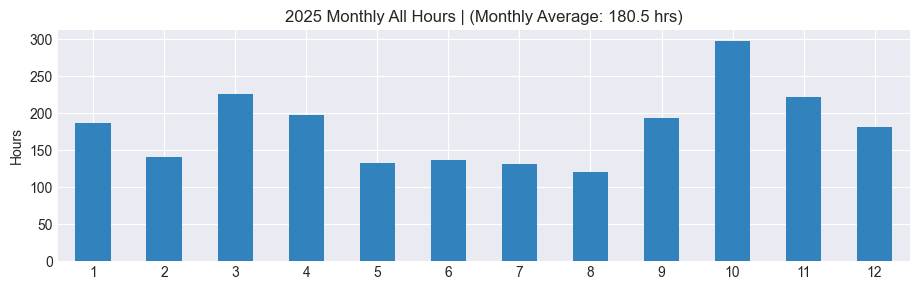

By Workspace Category:
| Workspace | Hours | % of Total |
|---|---|---|
| Startup Clients | 1,089 | 50% |
| My Startup Projects | 690 | 32% |
| Personal | 380 | 18% |
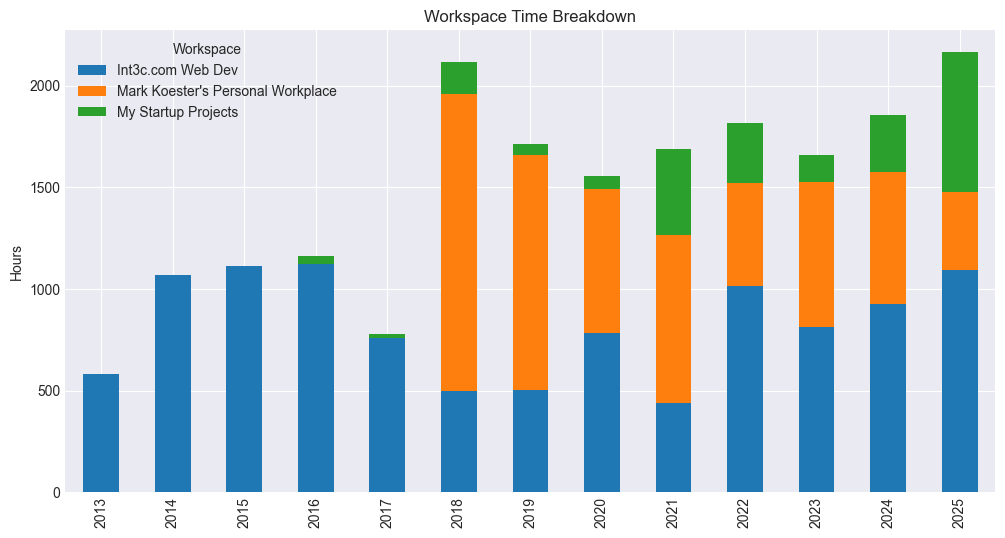
The “Big Picture” of My Project Time
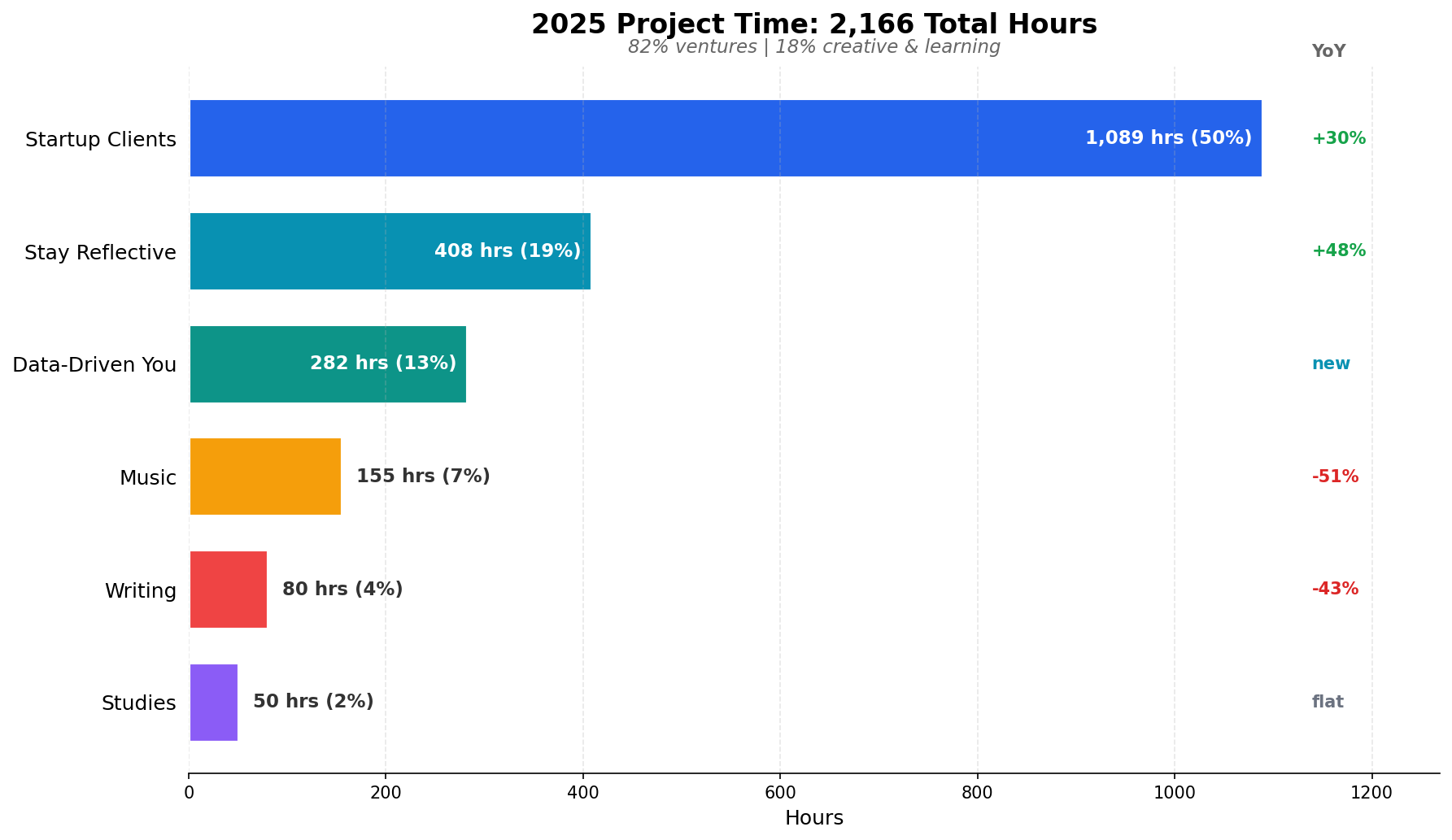
This visual tells the story: ventures dominate while creative work has shrunk to a sliver. Startup Clients alone account for half my tracked time.
Broken down by project categories:
| Project Category | Hours (2025) | % (of Total) | Change (YoY) |
|---|---|---|---|
| 🚀 Clients | 1,089 | 50% | +30% |
| 🛠️ Stay Reflective | 408 | 19% | +48% |
| 📱 Data-Driven You | 282 | 13% | (new) |
| 🎶 Music | 155 | 7% | -51% |
| ✍️ Writing | 80 | 4% | -43% |
| 📚 Studies | 50 | 2% | flat |
| 📁 Total Project Time | 2,166 | 100% | +17% |
How did the big picture of my 2025 look? 82% of tracked time went to ventures. Music and writing hit their lowest levels since I started tracking.
The Quarterly Story: Q4’s Surge
Out of 32 quarters tracked since 2018, Q4 2025 was my highest output quarter ever: 701 project hours. 🥵
The margin is significant. 2018 was a strong year for me; in fact, 3 of the top 5 quarters by Toggl hours are from 2018. But compared to the previous record (Q2 2018 at 562h), Q4 2025 is 139 hours more—a 25% increase. Interestingly, my computer time only increased by 28 hours (651h vs 623h), meaning I got dramatically more project work done per hour of screen time.
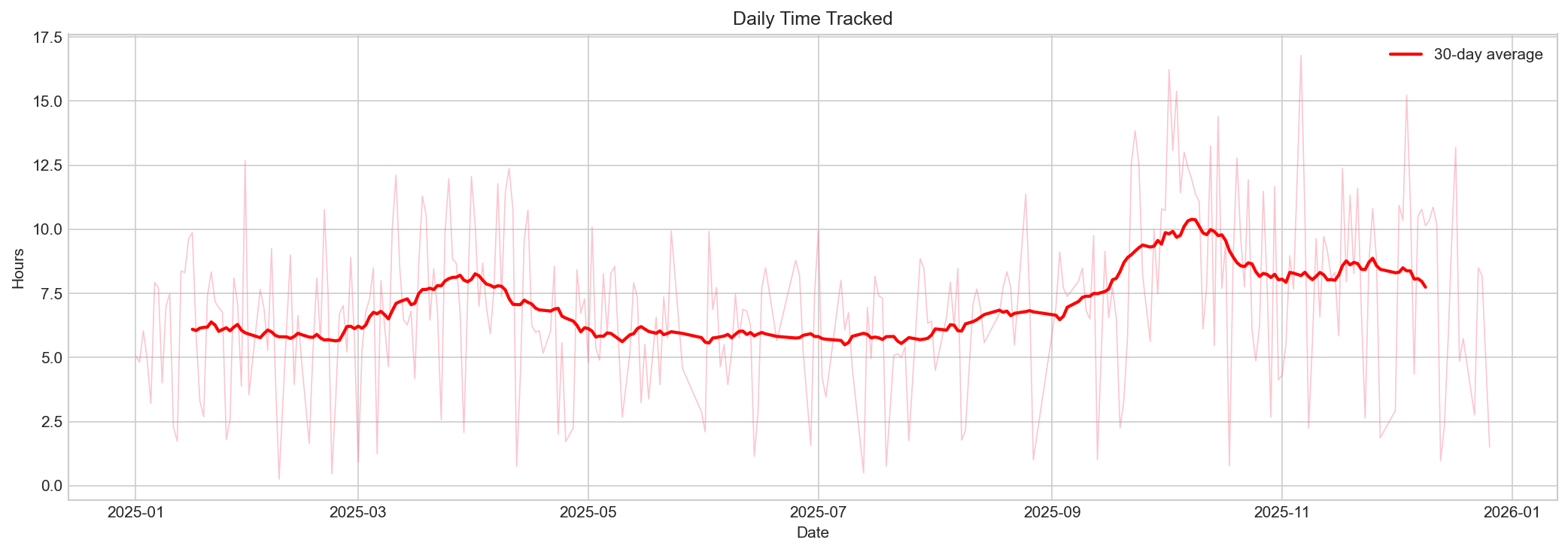
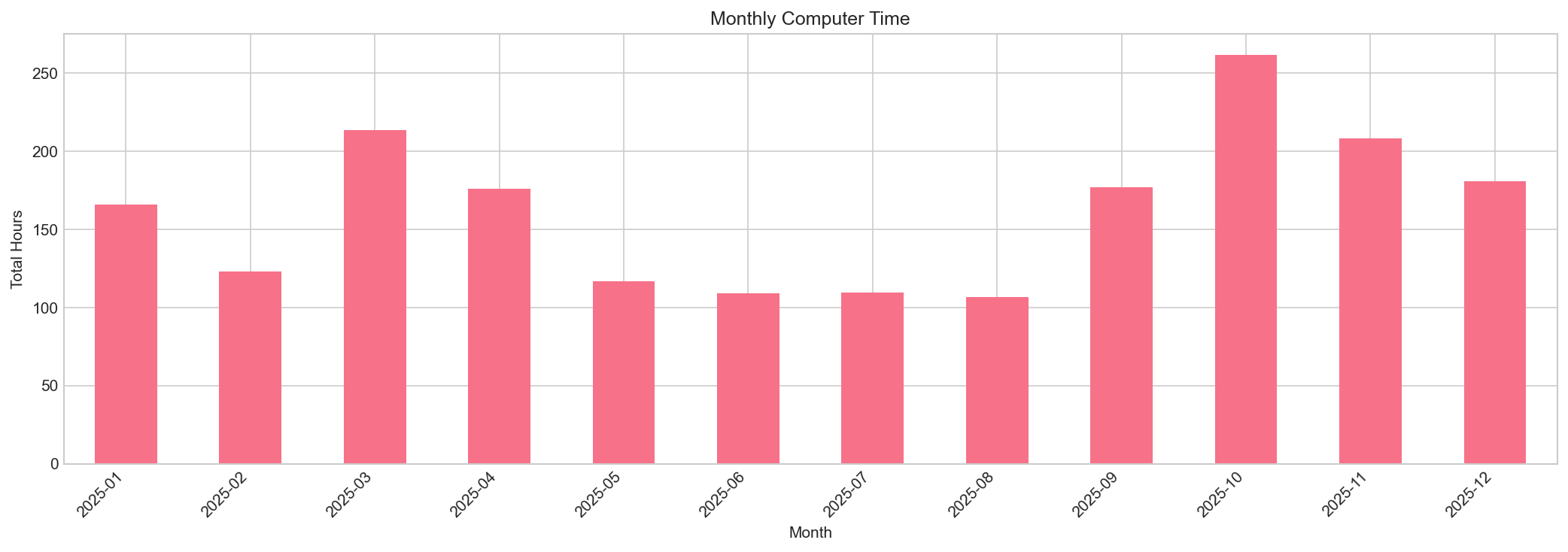

My Startup Projects includes Stay Reflective, Data-Driven You and Playback Pilot >
I spent 50% of my weeks in 2025 traveling. At the start of the year, I was forced to travel due to the Los Angeles fires and terrible air quality—a reminder of winters spent living in China. I took several trips to visit family too. In late June, we left Los Angeles and drove north for what became a 3-month Pacific Northwest road trip and experiment in working from nearly anywhere. The trip was wonderful—filled with adventures, new places, nature, and hiking.
Looking at last year’s data and previous years, I now clearly see my own “travel tax”: travel impacts how much time I spend at my computer, if and how I work out, and even my device and YouTube time.
As we wrapped up our last stay in San Luis Obispo in late September, I found myself pulled back into building. This resulted in a dramatic shift—more time on my computer, more project hours, and changes to my sleep patterns.
Here is a snapshot of my year segmented by quarters:
Quarter Summary
| Quarter | Hours | Productivity | Travel % | Notable |
|---|---|---|---|---|
| Q1 | 552 | 86% | 46% | Costa Rica, LA fires |
| Q2 | 466 | 87% | 38% | Lowest output |
| Q3 | 446 | 85% | 85% | PNW road trip, lowest running |
| Q4 | 701 | 87% | 31% | Record quarter, Stay Reflective surge |
Projects by Quarter
| Project | Q1 | Q2 | Q3 | Q4 |
|---|---|---|---|---|
| Clients | 349h | 263h | 304h | 174h |
| Stay Reflective | 54h | 102h | 11h | 240h |
| Data-Driven You | 11h | — | 62h | 209h |
| Music | 46h | 53h | 19h | 36h |
| Writing | 46h | 11h | 17h | 5h |
So, what changed? How did this Q4 surge happen?
A few factors converged:
- The Flutter Convergence. While I’ve spent most of my career using PHP, JavaScript, and Python, I started playing with Flutter in late 2023 and eventually launched Stay Reflective. Over the past two years, I’ve leaned heavily into Flutter development. Now, 3 of my 4 core tech ventures are built (or being built) with Flutter. This created a wonderful convergence where thinking and building one app helps me think and build others. My skilled practice in AI coding and Flutter made for a harmonious, focus and flow loop.
- Data-Driven You resurfaces. As we prepared to leave San Luis Obispo, I was pondering how I might turn my weekly review practice into a product. I’ve had this thought many times over the year. This thought had led me to revisit my QS Ledger project earlier in the year and transform it into a Flutter app leveraging self-tracking data I used during my time blog, i.e. Toggl and RescueTime. I called the initial app “Data-Driven You” and was exploring integrations and data visualization. As I was packing up, I had a couple hours to kill and little interest in client work. So, instead I asked myself, what if I mapped my weekly goals to tracked data? What if my goals management came with automatic data checks to see if I was hitting my time input intentions? Sparks flew and a new fire was lit. When we returned to LA in late September, I continued hacking on what became “Goals Vitality”.
- Client work naturally slowed. Q4 can go in a few directions for me. Both of my core client projects were closing out the year and were in largely maintenance mode with major initiatives paused until 2026. Client hours dropped from 304h (Q3) to 174h (Q4), as personal projects and startup building adventures ramped up. I didn’t consciously plan this. It just happened as I got pulled deeper into building.
- Stay Reflective tech debt sprint. After exploring and pushing on Goals Vitality, I found myself excited to work on Stay Reflective more. Stay Reflective’s development and progress has ebbed and flowed for me, but the spark of Goals Vitality led me to redirect energy back to Stay Reflective. I sorted out massive technical debt and developed the reflection facilitator dashboard and new share features. This alone accounted for 240 hours in Q4. A happy accident of being pulled into a personal interest enabled me to find renewed interest in a partially stalled project.
- Playback Pilot emerges. Even though I got obsessed with building it, early product feedback on Goals Vitality revealed several challenges and limitations. Goals span so many domains and can be pursued in many different forms and formats, making it hard to generalize into a singular user experience or product journey. Through testing, interviews and introspection, I determined that in its current form, GV was too ambitious and untethered to a specific use case. If the challenges of goal pursuit are ubiquitous and universal, what was a more specific area of my life I’d want to apply it too? Music! As a music maker, I’ve blogged and developed a host of techniques for improving my music producer skills, and I have released 6 albums to date. This eventually led me to consider combining aspects of Goals Vitality and Data-Driven You to create a progress-making focused, files and project manager app for finishing music that I called Playback Pilot. After 2-3 weeks of flutter dev, I shifted into early marketing efforts and created a landing page and waitlist. It’s been about a month and early interest and signups are looking good at nearly 400 beta interested signups. More updates coming soon!
Q4 2025 lit a spark in me and, upon analysis, a clear pattern emerges: returning home after extensive travel + a convergent tech stack + reduced client load + passionate projects = a perfect storm for personal project building.
So what was the cost of this Q4 product builder focus? Writing collapsed to just 5 hours in Q4 and was largely journaling and some goal planning. Being home led me to tap more into my music collaborators network and music held at 36 hours but still couldn’t compete with the pull of building. I wasn’t consciously sacrificing music, writing or other things. It’s just what happened when I got absorbed in product work.
The Zero-Sum Reckoning
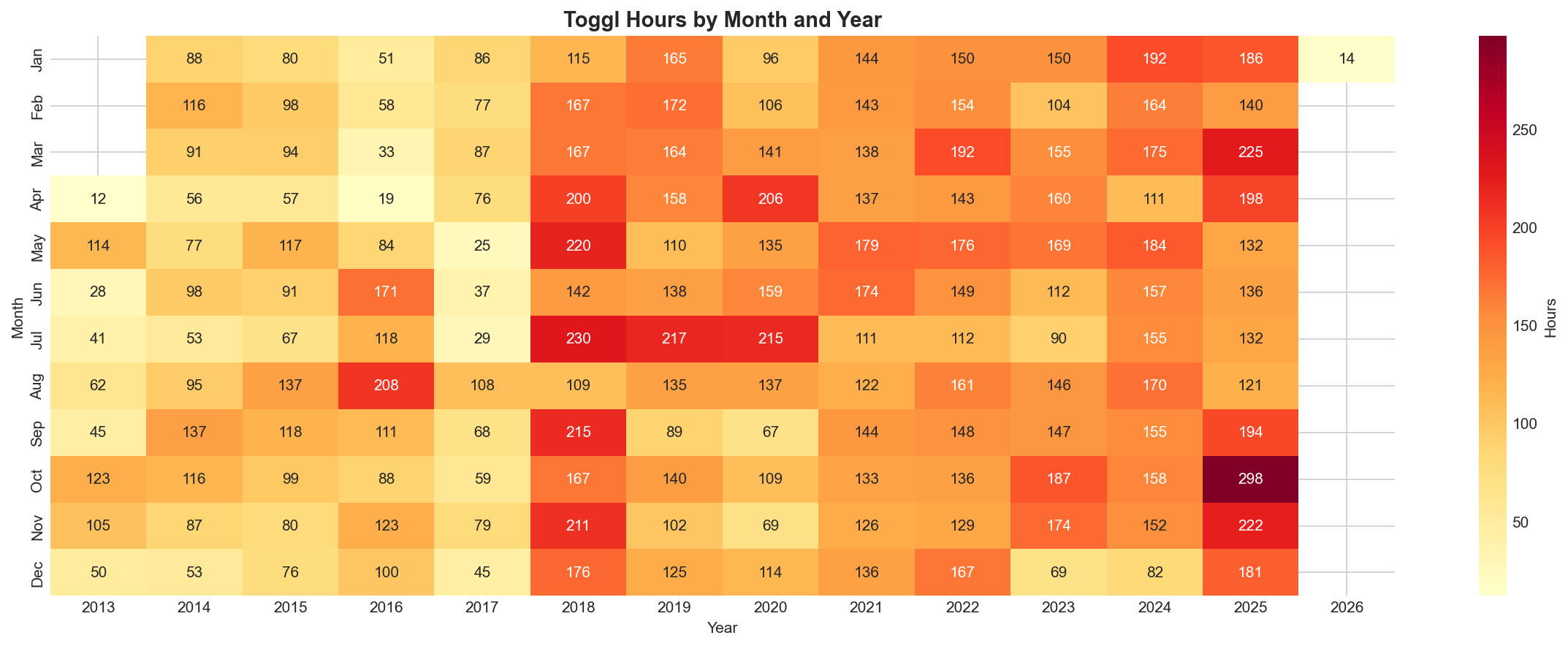
A zero-sum game is a situation where only one player can win and the other player or players must lose. In the purest sense, time management is largely a zero-sum game where one hour spent or invested in one area is an hour not spent elsewhere.
While each week, month or even year I try to think in terms of intentional choices and attempt to balance an equation where I allot enough time to reach certain goals and objectives, it’s often an impossible equation to get right. There is never enough time to do it all, even when I’m not traveling, skipping sleep and glued to my computer. Trade-offs are inevitable and choices are often intuitive and just seem to happen. My 2025 data reveals a story of undeniable tradeoffs:
| What Grew | What Contracted |
|---|---|
| Flutter Dev (Data-Driven You): +185h | Album Work (Music): -75h (-54%) |
| Dev Work (Client): +179h (+92%) | Jamming (Music): -53h (-40%) |
| SDK Work (Client): +174h (+269%) | Marketing (Client): -33h (-52%) |
| Flutter Dev (Stay Reflective): +161h (+571%) | Writing: -60h (-43%) |
My weekly patterns paint a pretty obvious picture of the linked patterns:
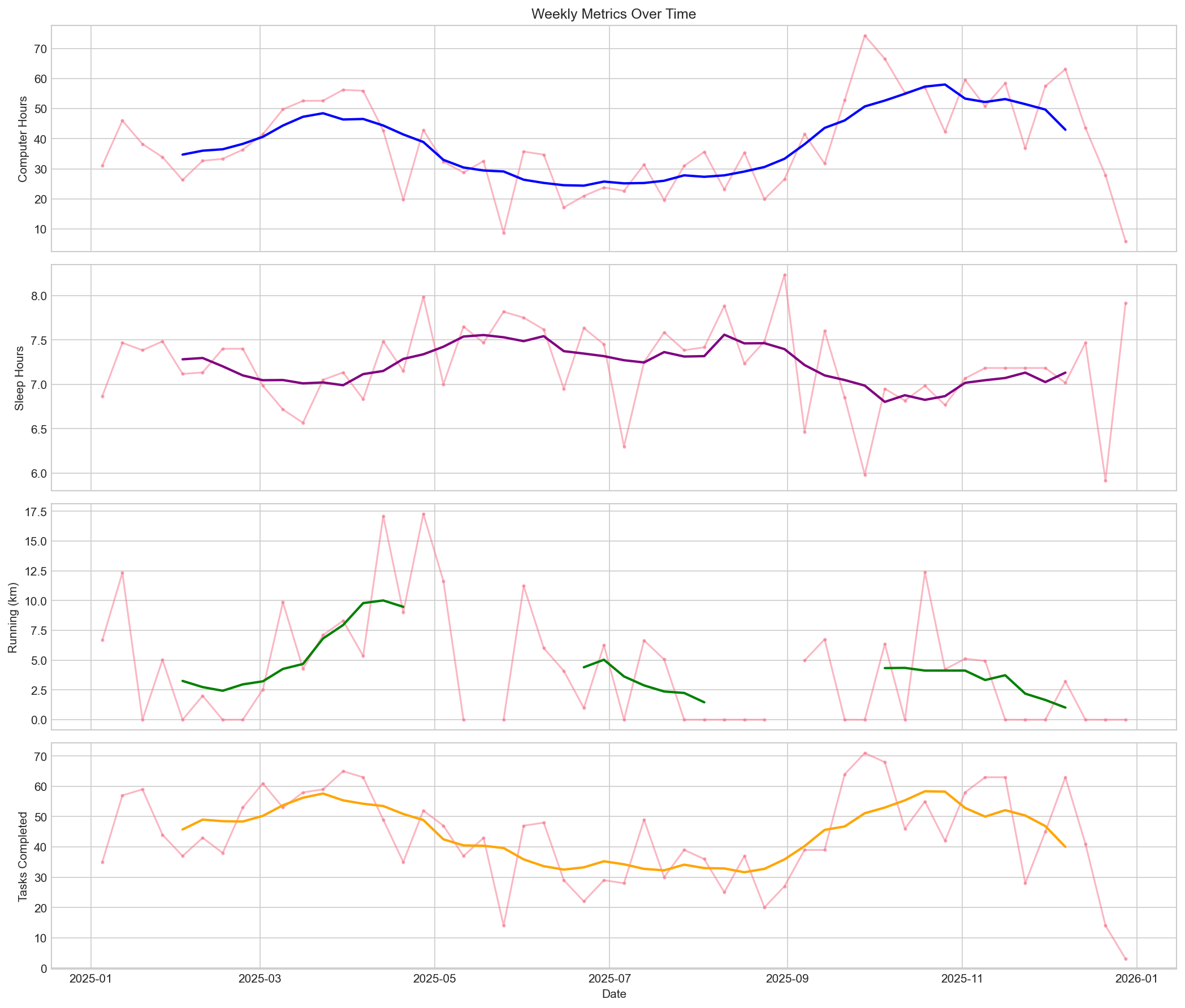
Key observations:
- Computer hours grew in two stages: A gradual rise through summer (30→45 hrs/week), then a steep Q4 surge (45→65+ hrs/week) as I returned home and dove into building.
- Sleep retreated dramatically: Started the year at 7.2 hrs, peaked around 7.5 hrs in Q2, then collapsed to under 7 hrs as computer time surged in Q4. The inverse correlation is unmistakable: more building, less sleeping.
- Running collapsed mid-year: Peaked at ~15 km/week in March-April, then cratered to near-zero during the Q3 road trip. The slight Q4 recovery never got back above 3 km/week. Travel killed the running habit.
- Tasks stayed surprisingly stable: Despite all the volatility in other metrics, weekly tasks completed held steady at 40-50 throughout the year. The what I worked on changed dramatically; the throughput didn’t.
The Creative Pivot: From Writing & Learning to Albums to Apps
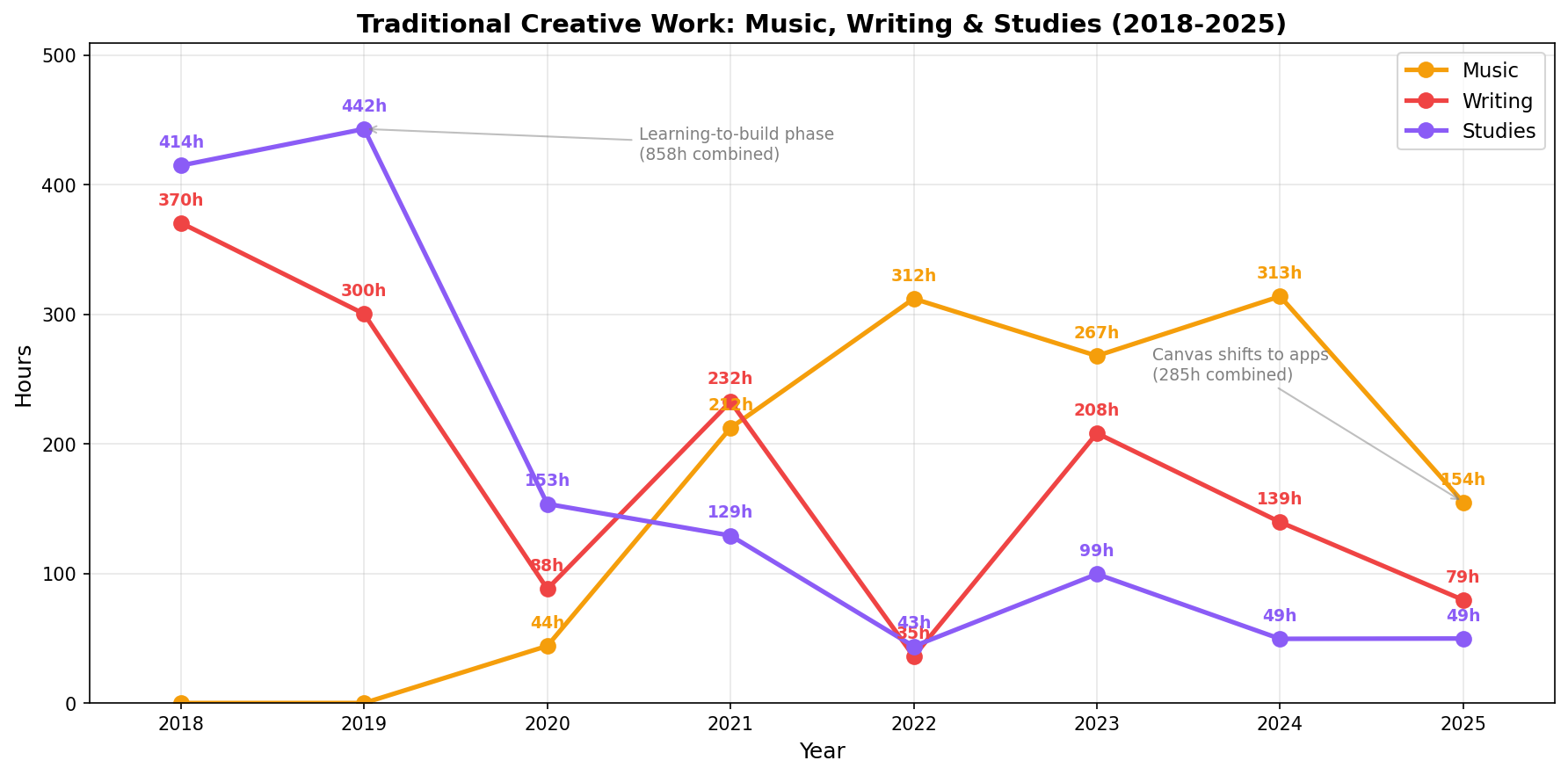
I feel priveledged to have spent so much of my life over the last severals year learning and creating. Looking at the trends from 2018 reveals an evolution and several creative shifts.
- Studies peaked in 2018-2019 (415h, 443h). This was my “learning to build” phase as well as a deep engagement with quantified self, psychology and goals. That intensive skill acquisition gave way to applied practice. I’m no longer studying technologies; I’m building with them.
- I started making Music in 2020 and my engagement peaked at 314h in 2024. My music time dropped to 155h in 2025. Collaboration narrowed from 8+ collaborators in previous year to one (Jacob). The details of my time logs reveal that I spend much less time learning and practices and what remained was the core: jamming and album work.
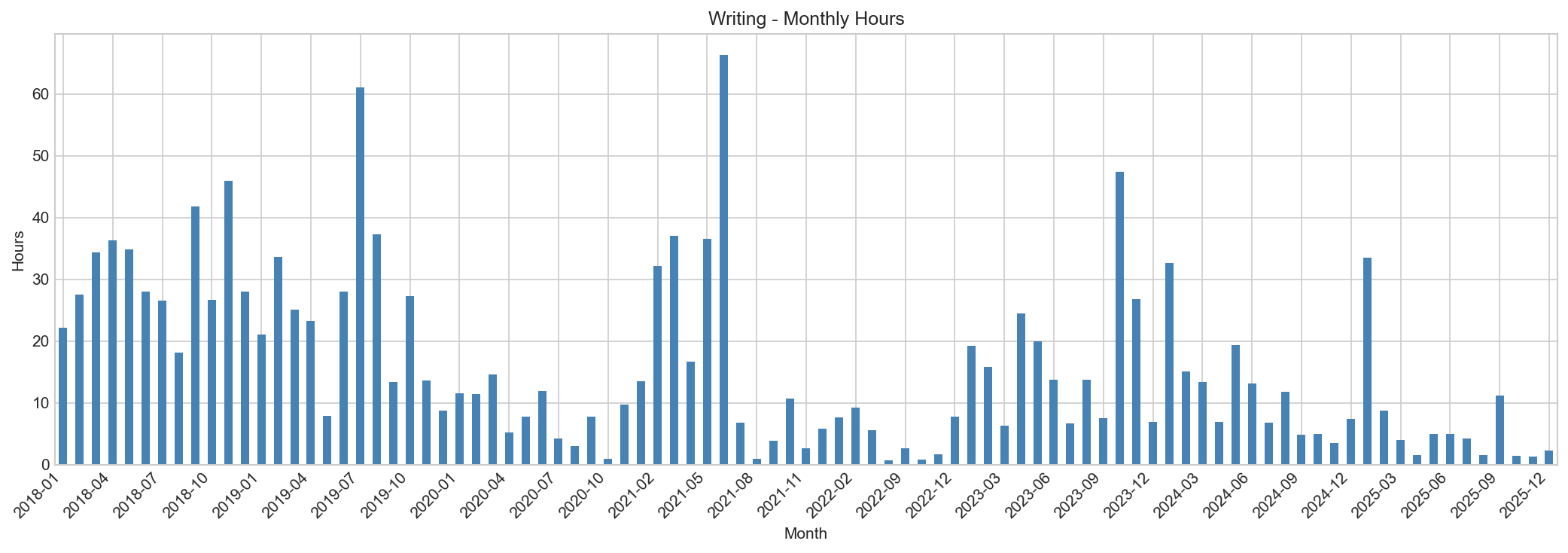
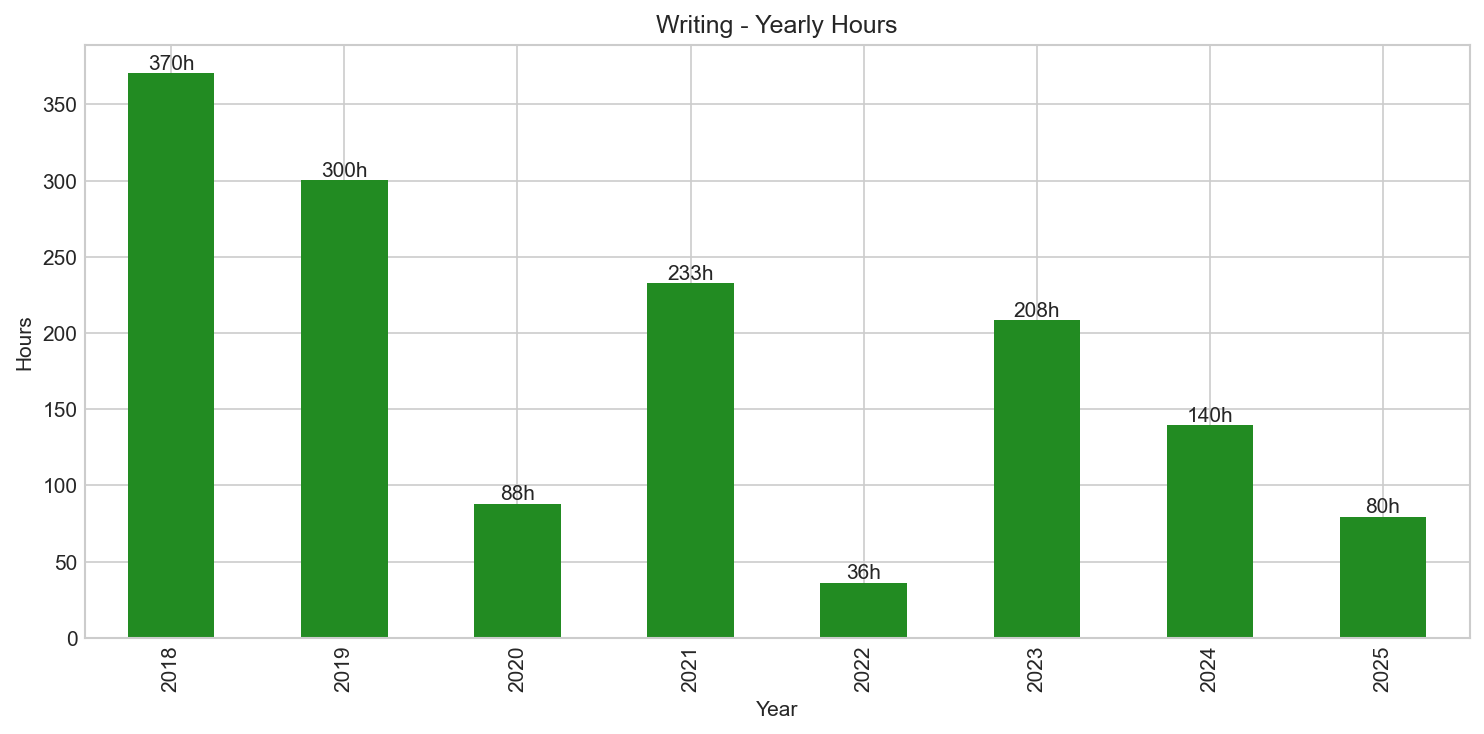
- I love to write but my writing habit has always been volatile. 370h in 2018, 36h in 2022, 208h in 2023, now 80h in 2025. Book projects and technical writing hit zero. What remained was journaling and annual reviews. I barely managed to publish anything in 2025 besides my yearly data reviews and a few book reviews.
Taken at face value, “traditional” creative work, like music and writing, hit historic lows in 2025. I definitely wasn’t as activated in these creative activities. But is building an app less creative than writing a blog post? Is designing a product experience less artistic than mixing an album?
I would argue that the ~1,000 hours I poured into development, product design, and shipping Stay Reflective and Playback Pilot tells a different story. Creativity didn’t retreat in 2025. It changed form.
| Creative Form | 2024 | 2025 | Change |
|---|---|---|---|
| Traditional (Music, Writing, Studies) | 504h | 285h | -43% |
| Technical (App/Product Building) | ~400h | ~1,000h | +150% |
| Total Creative Output | ~900h | ~1,285h | +43% |
Put metaphorically, my canvas or medium changed, but my creative impulse and interest didn’t. Building Stay Reflective or Playback Pilot doesn’t require the same problem-solving, aesthetic judgment, and iterative refinement as producing an album. Music is shipped as an .mp3 or .wav and blogs as .md, .doc or .html while apps emerge as .ipa. But in all cases I’m manifesting a tangible artistic creation which I deem essential to a lived human experience.
App-building counts as creative. That said, I do miss the balance and mix of a more complete artistic life. App creation isn’t the same. Music and writing engage different parts of my brain than coding. They are immersive creative experiences that coding or seeing a created app isn’t. The challenge, of course, is the zero-sum equations we must answer day-in, day-out and whether I want to also make space for my writing and music making and how much?
Conclusion: Insights from 2025 & Looking Ahead in 2026
What trajectory have I been on? Does it still align? Do I want to continue, shift, or dramatically change it?
My 2025 data tells a story of peak cognitive engagement: 2,166 project hours, a record Q4, and clear trade-offs. I built more than ever (1,000+ hours of development) but created less in traditional forms (music and writing at historic lows). Traveling 50% of the year brought adventures but came with a measurable “travel tax” on deep work.
Here are six insights from 2025:
- Cognitive Time has a speed limit. ~2,200-2,400 hours of focused work per year is my estimated ceiling or speed limit to how much effective time I can deliver in a year, based on eight years of data. In 2025, I put 2,166 hours into projects, which was a peak year for me to date, and Q4 2025 was a peak quarter. The constraint isn’t motivation or discipline; it’s time physics and our brain’s limits.
- The Travel Tax is real. 50% of my weeks in 2025 were spent traveling and brought incredible experiences but came with measurable costs: running collapsed (-55%), deep work diminished, and creative projects got squeezed. Travel weeks averaged 5.5 hrs/day on computer vs 7.2 hrs during home weeks. Leaving aside whether a travel week is of vacation, work or hybrid, each travel week costs ~19 hours of cognitive capacity on average. I can’t necessarily work harder or longer, but I can prioritize and design for more time at home.
- Convergence creates flow. Q4’s record-breaking output (701h) wasn’t random; it emerged from a specific formula: returning home after travel + a unified tech stack (Flutter) + reduced client obligations + passionate personal projects. When thinking about one app helps you build another, you enter a compounding productivity loop. As someone who tries to accomplish a lot, this idea of convergence and simplification to a unifed goal is a life principle to remember.
- AI tools enabled more building, not less. Counter to the “AI replaces developers” narrative (which is also happening), Claude Code and similar tools fueled more hands-on development. My coding hours nearly tripled year-over-year. AI didn’t automate me; it amplified me. This abilility to create more is key but should align with human intentions and human-led creativity.
- Creativity pivoted, not retreated. Traditional creative hours (music, writing) hit historic lows. But ~1,000 hours of product building tells a different story. When you count apps as art, my creative output actually increased 43% last year. The canvas changed; the impulse to create didn’t.
- Passion pulls harder than discipline pushes. My peak productivity wasn’t driven by forcing myself to work harder. It came from being pulled into projects I cared about (Stay Reflective, Playback Pilot, Goals Vitality). This included deep project engagement on my clients’ healthtech and biotech needs too. Flow states emerge when interest and challenge align with capability.
As I look at 2025 and beyond into the year ahead in 2026, the question for me isn’t really about whether I spent my time right or wrong, well or poorly; but instead reflecting on whether the trajectory of my time is something I align with, still accept or want to change and redirect?
I strongly believe that time management is deeply existential, and that in not choosing, you are still make a choice. All in all, I’m content with the trajectory I’m on. I want to continue to lean into building and software development. I want to stay active, exercise and prioritize sleep and health. I do feel like I neglected or sacrificed some aspects of my creative self in 2025, like music and writing, and I intend to allot more time to those in the year ahead. My creative shift or retreat in 2025 shouldn’t be permanent.
My Intentions for 2026
- Shift More into Marketing and Growth Mode: After a year of nearly exclusive focus on product development, I was determined to end 2025 and start 2026 with my attention put into marketing and growth. You can’t just build it; you need to grow through customer-centricity and iteration.
- Ship Playback Pilot. My momentum from Q4 continues and I aim to finish and launch a beta soon. I’ll then iterate based on early user engagement and feedback. Let’s see if this product has legs.
- Grow Stay Reflective. My pilots over the last two years have been incredible. The “reflection tools for coaches” and dashboard are nearly built and I have several parties interested. Now it’s about finding and getting them into the hands of coaches, teachers, and thought leaders.
- Protect creative time. Stay all-in on building, but carve out space for music and writing. Finish Album 7 in Q1—it’s 50-60% done and needs only 60-80 more hours at 5-10h/week. Seek collaborators to stay engaged. The formula is simple: consistent small inputs compound into finished work.
- Maintain the travel balance. Even though much of it was forced, 50% of 2025’s travel weeks was likely too much and unsustainable. Instead, let’s aim to travel less at the start of Q1 until I ship certain outcomes. Overall, maybe aim for 30-35% of year spent travel, preserving that spirit of adventure, hiking and new places without the tax on deep work.
- Keep Tracking Time & continue the weekly review practice. After 8+ years, the combination of time tracking and weekly reviews lies at the foundation of my productivity and goal pursuit methodology. Tracking brings data and makes all this reflection possible.
Thanks for reading! Here’s to another year of tracking, building, and figuring it out as I go.
Appendix
Creative Deep Dive: Music & Writing
Music (155 hrs, -51% from 2024)
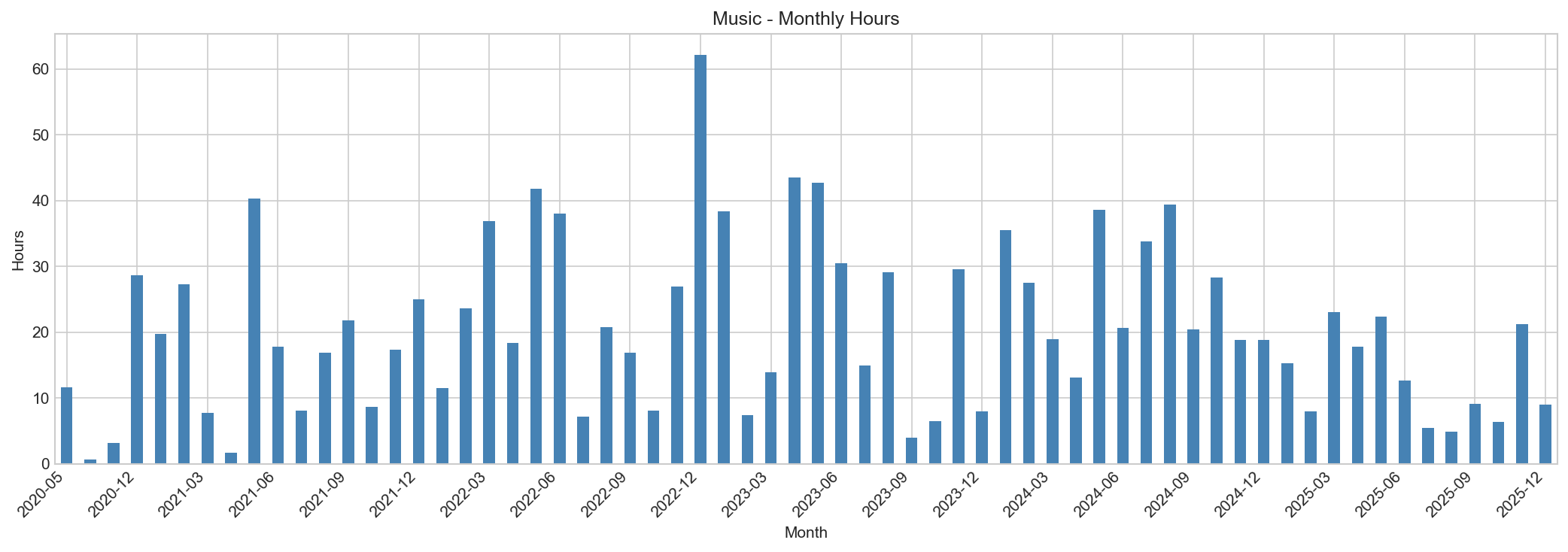


2025 Breakdown:
- Music Production Jamming: 26 hrs
- Album Reworking: 17 hrs
- Jamming with Jacob: 14 hrs
- Album Reworking with Jacob: 14 hrs
- Jamming with Vocals: 10 hrs
Writing (80 hrs, -43% from 2024)
2025 Breakdown:
- Journaling: 20.5 hrs
- Year in Time: 10.5 hrs
- Year in Creativity: 8 hrs
- Travel Diary: 5 hrs
- Book Review Blog Post: 3.5 hrs
2025 Published Posts:
- Jan 4: Book Notes: The Mind Is Flat
- Jan 13: A Year in Book Reading: 2024
- Jan 15: A Year in Time: 2024
- Jan 24: Book Notes: The Reflective Practitioner
- Feb 28: A Year of Creativity: 2024
- Sep 4: Book Notes: A Thousand Brains
Tools Used
- Toggl - Project time tracking (8+ years)
- RescueTime - Computer activity monitoring
- Oura Ring - Sleep tracking
- Strava - Exercise tracking
- Apple Health - Movement and workout data
- Weekly Review - Manual data aggregation
Previous Year in Time Posts
AIDA (AI Disclosure Acknowledgement): This post was written by me with the aid of AI tools. I leveraged AI systems (Claude) for data processing, analysis, visualization, and initial outline generation. For ideation and big themes identification, I used Claude and Google’s NotebookLM.